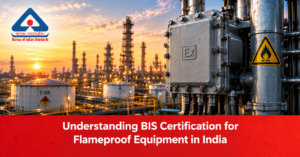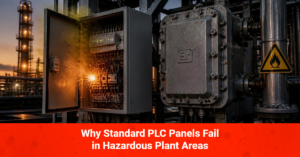
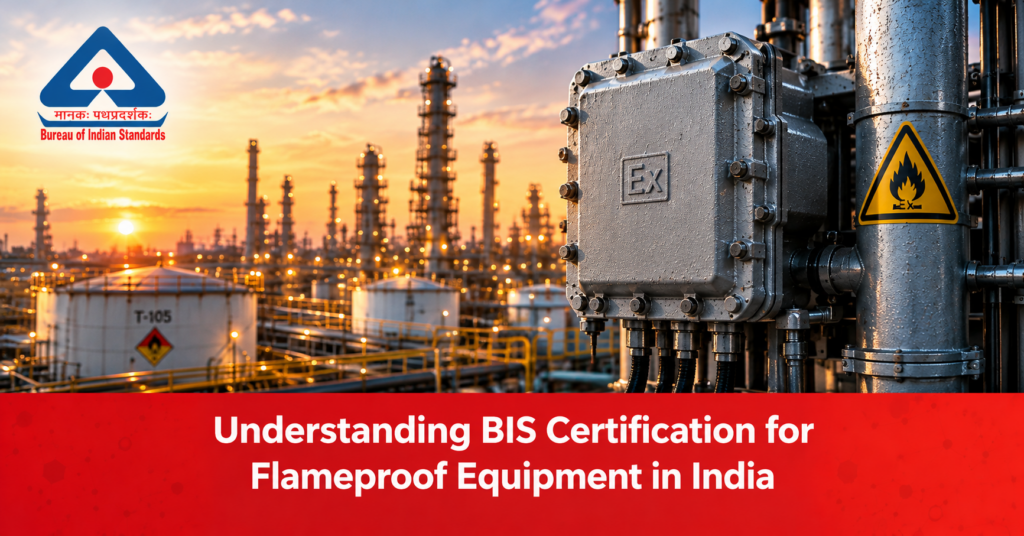
A small electrical spark can cause a huge explosion in these dangerous places. Hence, industries use equipment manufactured for flame-proofing because it is designed so that an internal flame does not spread over a large area.
But purchasing a device with the label “flameproof” isn’t sufficient. It is important to check its official safety standards in India. Flameproof equipment comes into the picture in this scenario with BIS certification.
This guide provides an introduction to what is involved in BIS certification in India, which standards are relevant, how it operates, and how to verify the presence of genuine safety marks before buying electrical equipment.
What Is BIS Certification and Why It Matters
The national standards in India are based on the Bureau of Indian Standards (BIS). The Ministry of Consumer Affairs, Food & Public Distribution controls the BIS.
Therefore, what is BIS Certification? It is a symbol indicating conformity to a specific standard of safety, quality, and performance for a product in India. Upon award of a BIS licence, the manufacturer receives permission to affix the official ISI mark for flameproof equipment or appropriate logos to the products.
For hazardous area electricals, the certification of flameproof equipment is essential as:
- Resists industrial disasters: Explosion-proof tested enclosure.
- It provides structural strength: Certified units are designed to resist pressure caused by high temperatures and pressure.
- Builds buyer’s confidence: Consumers have assurance that the product has been tested by a third-party laboratory.
This applies to control gear as well as enclosures. For example, a flameproof/explosionproof panel with valid certification gives plant managers proof that the entire control system is safe for use in hazardous zones.
Which IS Standards Apply? (IS/IEC 60079 Series)
The hazardous area electrical standards followed in India are similar to the International Electrotechnical Commission (IEC) standards set by the international community. IS/IEC 60079 is the standard that regulates explosion-proof electrical equipment.
For the case of Ex d flameproof protection, the standard to refer to is IS/IEC 60079-1 flameproof enclosure. Enclosures such as a flameproof explosion-proof junction box are tested against this standard to confirm they can contain an internal explosion without igniting the surrounding atmosphere.
The term flameproof is defined within IS/IEC 60079-1.
- A flameproof enclosure (type ‘d’) is constructed such that:
- It is able to resist damage from an internal explosion of an explosive gas mixture.
- It avoids the release of internal flames or hot gases to the outside environment through joints or gaps in the structure.
The IS/IEC 60079 series is used to verify safety in the design and manufacture of the light fixture or heavy-duty control panel, depending on which is being installed.
Is BIS Certification Mandatory in India?
Always check the latest BIS and Gazette notifications to confirm whether certification is mandatory for your product category.
The regulatory framework for hazardous locations in India is a complex one, with several regulatory bodies at play, including the Petroleum and Explosives Safety Organization (PESO). Equipment use is controlled through the use of equipment rules, e.g., Gas Cylinders Rules and Petroleum Rules.
Applicability and acceptance of BIS standards in compliance with other approvals, as mentioned (on its official website/web link), technical regulations. Purchasers should always pay attention to the notifications published by the Gazette or the official website of BIS to check mandatory compliance lists.
BIS vs IECEx vs ATEX vs PESO
Certifications can be a bit confusing to navigate. These are the differences between these standard regimes:
Certification | Region / Body | Scope & Role |
BIS (ISI Mark) | India (Bureau of Indian Standards) | For site approval, PESO may ask for a test report from a recognised laboratory showing the enclosure conforms to IS/IEC 60079-1. |
PESO | India (Petroleum & Explosives Safety Organization) | A statutory body that approves the use of equipment in hazardous locations in India. |
ATEX | European Union | Mandatory directive for equipment used in explosive atmospheres within the EU. |
IECEx | Global (IEC System) | International certification system facilitating global trade in Ex equipment. |
In India, the PESO might have to obtain a test report from a well-known testing laboratory and/or from an IS/IEC 60079-1 approved testing facility for the flameproof enclosure to obtain the site operational approvals.
Step-by-Step BIS Certification Process
Three components are required to get the BIS certification for the flameproof equipment: Testing and factory evaluation.
Step | Phase | What Happens |
1 | Application | The manufacturer submits an online application on the BIS portal with specifications. |
2 | Document Review | BIS officers review technical documents, test reports, and manufacturing details. |
3 | Factory Audit | A BIS auditor visits the facility to inspect production quality control and equipment. |
4 | Sample Testing | Product samples are sent to a BIS-recognised laboratory for explosion and flame path testing. |
5 | Licence Grant | The BIS provides a BIS licence if reports of sample testing are found to be satisfactory on the basis of IS/IEC 60079 requirements. |
6 | Surveillance | To ensure compliance, BIS periodically visits the markets unannounced and carries out market sample testing. |
Documents Required and Timeline
For an effortless BIS certification process, the manufacturers need to prepare technical dossiers beforehand.
Key Documents Needed:
- Registration certificate from the factory and site layout plan.
- A flowchart of manufacturing processes and a list of the machines used.A manufacturing process flowchart and machine listing.
- Calibration certificates for testing instruments are valid.
- Technical drawings of the flame path and dimensions of the enclosure.
- Test report from a recognised laboratory by BIS.
Estimated Timeline:
The overall process should take 1-3 months for domestic manufacturers, depending on the duration of testing at the recognized lab and the accuracy of the documents.
How to Check a BIS Licence or ISI Mark
As a buyer, you are safeguarding your plant from fake equipment by checking for authentic certification:
- Check for ISI Mark: The ISI mark is printed on the nameplate of the product (e.g., flameproof explosion-proof junction box).
- Identify the CML Number: At the base of the ISI, the License Number (CM/L-XXXXXXX) will be found.
- Verification at the official BIS online portal Manakonline – Please verify using the CM/L Number on the official BIS web portal – Manakonline.
- Check for Product details: Ensure the manufacturer name, range, and type of equipment (e.g Flame proof/explosion proof panel), and the expiry date match.
Quality documentation is also available on our certificate page.
Common Buyer Mistakes
Simple non-compliance errors will compromise the safety of a plant in the long term:
- Trading ATEX for Indian Approvals: Assuming that ATEX or IECEx certificates can substitute the local requirements.
- Failure to consider Equipment Scope: When an appropriate licence number is entered, but it is not noticed that the licence is for a different size of equipment than the one actually purchased.
- Failure to Check Expiration Dates: Use of old compliance certificates that are out of date.
- If your plant handles Gas Group IIC gases (e.g., hydrogen), buy Ex d IIC equipment.
Conclusion
BIS certification confirms that equipment meets the applicable IS/IEC 60079 requirements. Final suitability still depends on the hazardous area classification, gas group and PESO or site approvals. Make sure the items that you purchase are in compliance with the IS/IEC 60079 requirements to ensure these items will be safe for your installation and employees. Always make sure to check the licence number and nameplate before buying.
FAQs
The main standard being applied is IS/IEC 60079-1, which contains the design, construction, and testing requirements of Flameproof enclosures (‘d’).
Mechanical, electrical, and explosion tests of the equipment sample are conducted by an independent laboratory recognised by BIS to ensure compliance with the requirements before BIS issues a licence.
The protection provided by this is an enclosure that is built to withstand an explosion inside and prevent flames from escaping. Other types simply deal with trying to stop the sparks or the high temperatures to begin with, such as, for example, Ex e or Ex i.